Ferdowsi and Us
Shahnameh, the Book of Kings: the monument, the man, and the epic within us

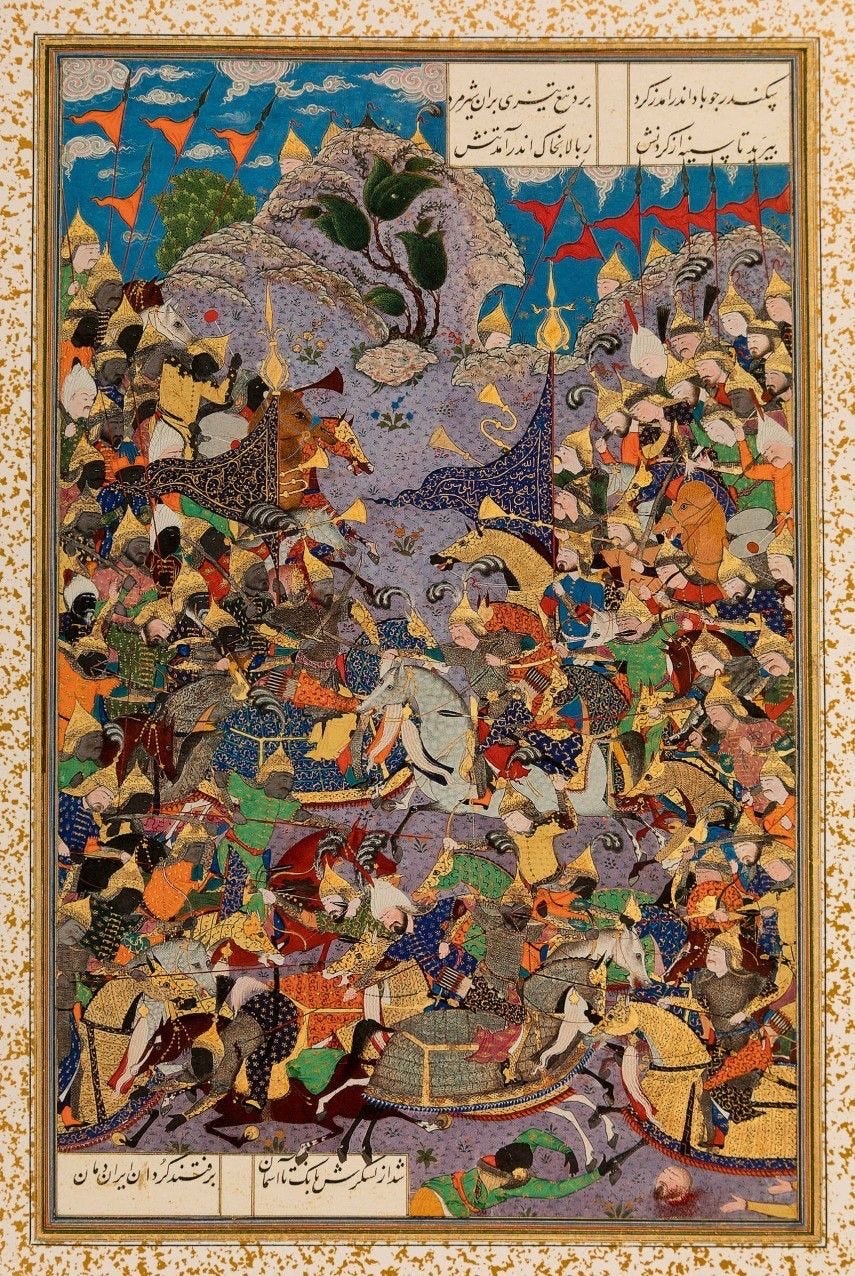
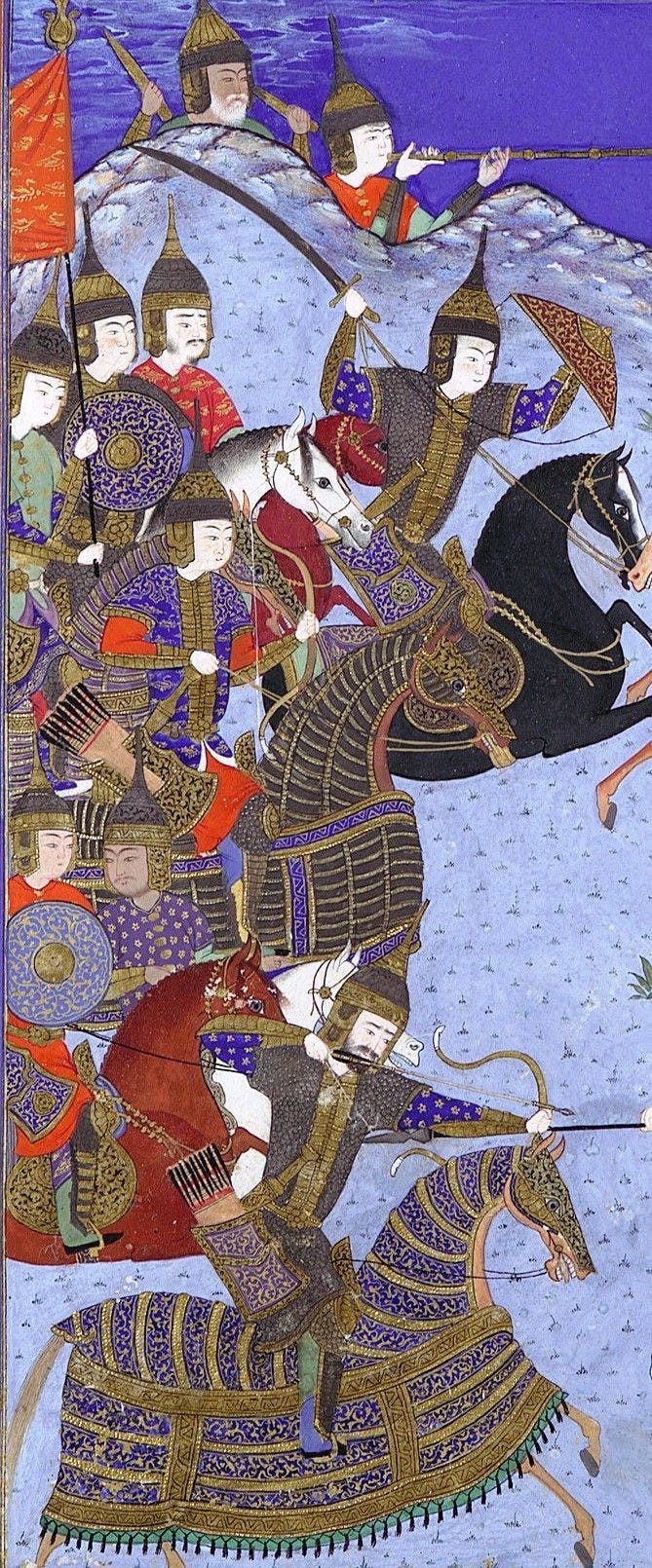
The Shahnameh, the Book of Kings, is the immense epic poem that Ferdowsi of Tus, in northeastern Iran, brought to its final form on 8 March 1010, a little over 1,016 years ago. Written in literary Farsi, it extends to nearly 60,000 verses, about 50,000 distichs, or roughly 100,000 lines, and is regularly described as almost twice the size of the Iliad and the Odyssey combined. To describe it only as the Iranian national epic is however insufficient. It is also one of the great monuments by which a civilization kept hold of its language, its memory, and its historical dignity.
The Monument Before the Text
از آن پس نمیرم که من زندهام
که تخمِ سخن من پراگندهام
From then on I shall not die, for I am alive,
for I have scattered the seed of speech.
These lines appear near the end of the Shahnameh, the Book of Kings, in the Yazdgerd III section, after Ferdowsi had spent more than thirty years completing this monumental work.
These words say, with extraordinary calm, what the poem meant to the man who made it. They speak at once of posterity, legacy, civilization, and the future of Iran’s language, Farsi.
But Ferdowsi is not addressing an abstract future. He is naming, across more than a thousand years, the generations who would come after him, inherit his language, receive his work, and continue to live in the civilizational world his poem helped preserve.
He is calling on us, now.
For more than forty years, I lived in the presence of Ferdowsi without really reading him. Like many Iranians, I knew what he meant to Iran and to our collective heritage, long before I entered the book itself. His mere existence was sufficient, as a source of the deepest pride.
He existed in our homes, in our parents’ mouths, in the tales families pass on orally to children. The Shahnameh lay on tables and shelves, not always opened, still less studied, but it was there, and its mere presence carried weight, almost like that of a sacred book.
Ferdowsi could remain unread and still be formative.
His existence itself had become an act of historical resistance, because it guaranteed that Farsi, memory, and civilizational depth had not been erased.
Part of the reason I did not open the Shahnameh for so long was reverence. The other part was its reputation. We had heard the tales and some verses, but we had also heard that the book was difficult to read: too vast, too elevated, too inexhaustible, a work one could spend a lifetime studying and still not master.
Its difficulty does not lie only in old vocabulary, but in its scale, its dense allusions, its intricate textual history, and the fact that more than a thousand manuscripts and fragments survive. Centuries of commentary have still not exhausted it. One can spend a lifetime on the Shahnameh and still remain, in some sense, before it.
That is why so many Iranians know the Shahnameh, before they actually study it.
It took Ferdowsi more than thirty years to write it; it could take us a lifetime to understand it.
But monuments are made by men, and the Shahnameh was forged over decades, at the cost of a man’s life.
The Man Beneath the Monument
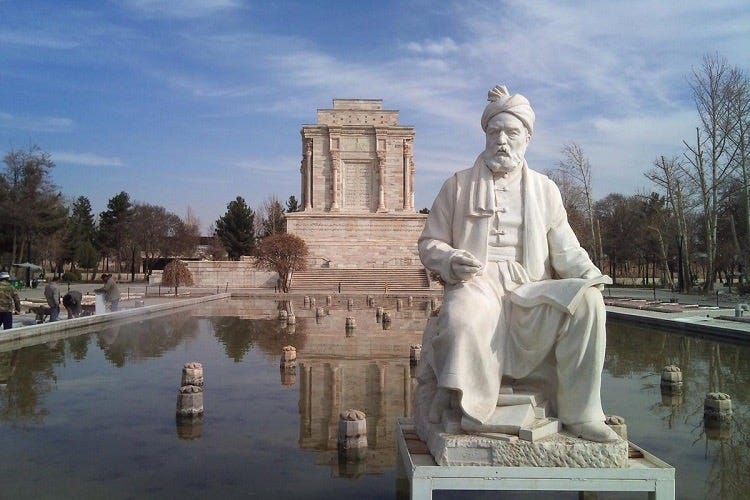
Earlier versions of the Book of Kings existed in written form; the stories behind them also lived in oral tradition. A prose Shahnameh had been compiled in Tus in 957, and the poet Daqiqi had already begun to turn part of that inherited material into verse before his death. What Ferdowsi gave was not invention ex nihilo, but something rarer: endurance, architecture, and monumental form. Without him, that scattered inheritance might never have become the work later generations received, forged through more than thirty years of sacrifice.
A Responsibility Inherited from His Class
Ferdowsi came from the dehqān class, a landowning Iranian elite that saw itself as the guardian of lineage, local prestige, and the memory of pre-Islamic Iran. What Ferdowsi took on was not only a private ambition. It answered a responsibility tied to that social world, to his “milieu”. The dehqāns had made the preservation of Iran’s older memory one of the ways they imprinted their place in history.
What Ferdowsi carried forward was therefore larger than himself from the beginning: not merely stories, but a civilizational inheritance.
The Historical Urgency of Preserving Farsi
Ferdowsi also began his work at a moment when literary Farsi was rising, but not yet secure. Under the Samanids, it had re-emerged as a language of poetry, court culture, translation, and prose, while older Iranian memory still found some shelter at court. By the time he finished, that world had changed. The Samanids had fallen; Arabic still dominated religion and high scholarship; and the prestige of Farsi was not yet beyond challenge. The danger was not immediate extinction, but diminishment: the risk that Farsi would remain secondary, and that pre-Islamic Iranian memory would lose standing in the new order.
The Shahnameh answered that danger by giving Farsi a monument so large and so authoritative that it could no longer be denied the weight of a civilization.
The Necessity Born of His Own Life
The Shahnameh is not only a vast archive of kings, wars, dynasties, and civilizational memory. At certain moments, the man writing it becomes visible inside it: not continuously, not in any modern autobiographical sense, but in fissures: when he speaks of age, poverty, bodily pain, dependence, the death of his son, and the hope that words will carry him beyond death.
Ferdowsi grew older, poorer, and increasingly dependent on patrons, one of whom died, leaving his already fragile material situation even more precarious.
In the later parts of the poem, he speaks of pain, hardship, and need. That matters because it shows that the Shahnameh had become more than a cultural duty. It had become something he personally needed in order to endure the narrowing of his own life. The work was no longer only what he gave to Iran; it was also what allowed him to keep going.
In the Yazdgerd section, he writes:
چو بگذشت سال از برم شست و پنج
فزون کردم اندیشه و درد و رنج
به تاریخ شاهان نیاز آمدم
به پیش اختر دیرساز آمدم
When sixty-five years had passed over me,
my thought and my pain and hardship grew.
I came to need the history of kings;
I had come before the slow-turning star.
Iranica notes that in different late passages Ferdowsi complains of old age, pain in his legs, failing eyesight, the loss of his teeth, and the fear of dying before he could finish the book. The sacrifice of those decades was therefore not only mental or literary. It was physical. The body enters the history of the poem.
So does humiliation. A few lines later, he writes:
جز احسنت از ایشان نبود بهرهام
بکفت اندر احسنتشان زهرهام
From them I had no share but “well done”;
my very gall was split by their “well done.”
This is not the voice of a man serenely conscious of immortality. It is the voice of wounded dignity. Praise has become useless because it does not relieve need. What began as inherited duty hardens here into personal necessity.
The deepest wound came in 1006, with the death of his son, at the age of thirty-seven. Ferdowsi inserts the elegy into the narrative of King Khosrow Parviz:
مرا بود نوبت برفت آن جوان
ز دردش منم چون تن بیروان
It was my turn, yet that young man went;
from his pain I am like a body without a soul.
And later, something even more personal broke through the poem, his difficult relation to his own son:
جوان را چو شد سال بر سی و هفت
نه بر آرزو یافت گیتی برفت
همیبود همواره با من درشت
برآشفت و یکباره بنمود پشت
When the young man had reached thirty-seven years,
he left the world without finding it as he wished.
He was always harsh with me;
he flared up and all at once turned his back.
This is the place where the monument opens and a man appears inside it.
And yet this is precisely what restores Ferdowsi’s grandeur. Not the idea of a monumental poet standing above life, but the truth that he gave more than thirty years, under political pressure, in poverty, with bodily pain, and through grief, to make sure that Farsi would inherit a monument large enough to resist diminishment. To return from the monument to the man is not to reduce him. It is to see, at last, what it cost him to become what he became for us.
The Epic Within Us, Today
The Shahnameh is still alive in our everyday lives today. It remains one of the deepest foundations of Iranian civilizational identity: a source of pride, continuity, and pre-Islamic memory to which Iranians return to, especially in moments of adversity.
We return to it because it gives more than language. It gives strength. When the present becomes too brutal to be borne in ordinary speech, we reach back into our collective inheritance and invoke the monsters and tyrants our myths have already named for us. That, too, says something about Iranians: even under pressure, we turn instinctively to poetry, symbol, and the deeper resources of civilization.
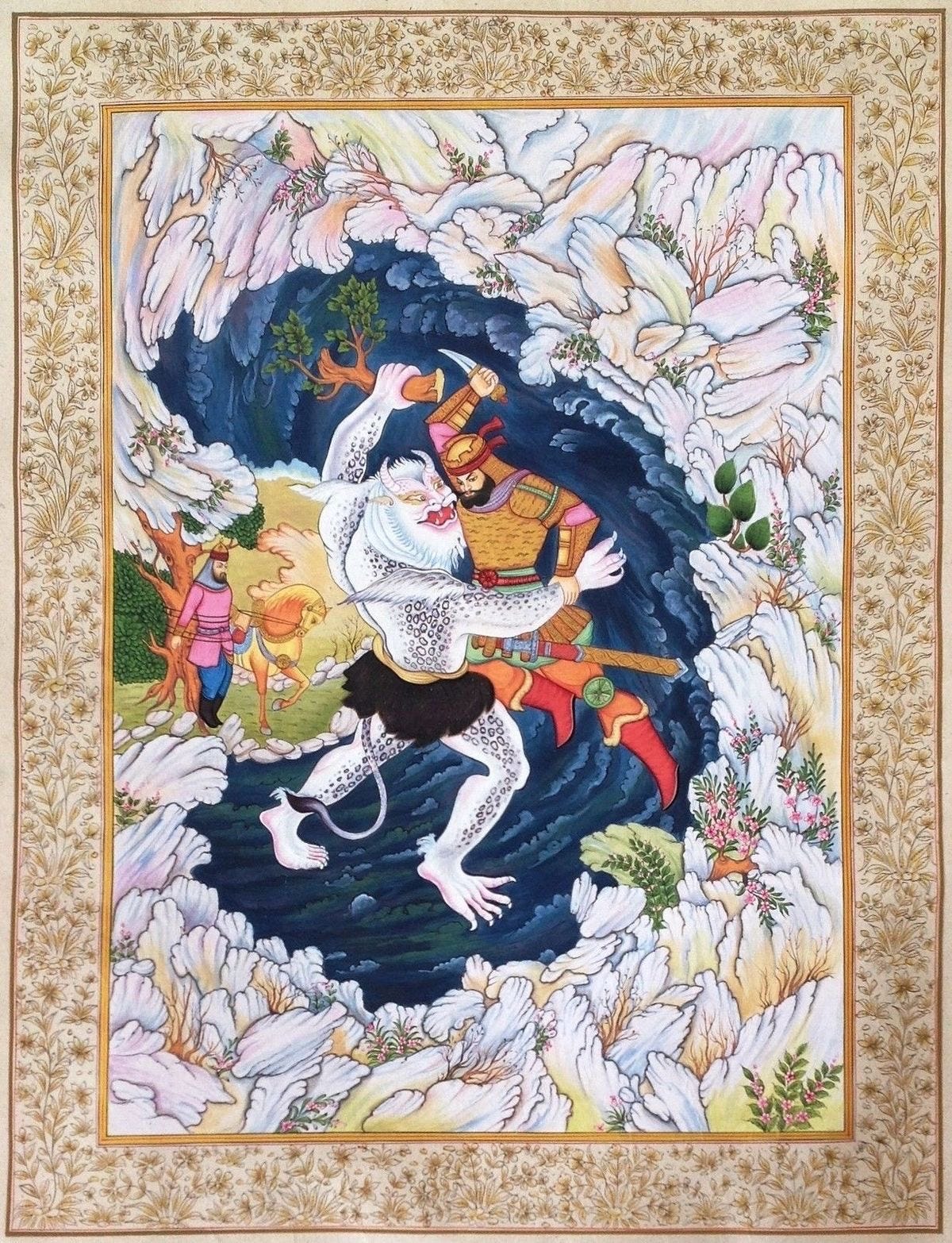
One of the most evil monsters of the Shahnameh, Zahhak, has been named by protesters in the past few weeks, mirroring a perfect analogy with the real monsters we are facing today.
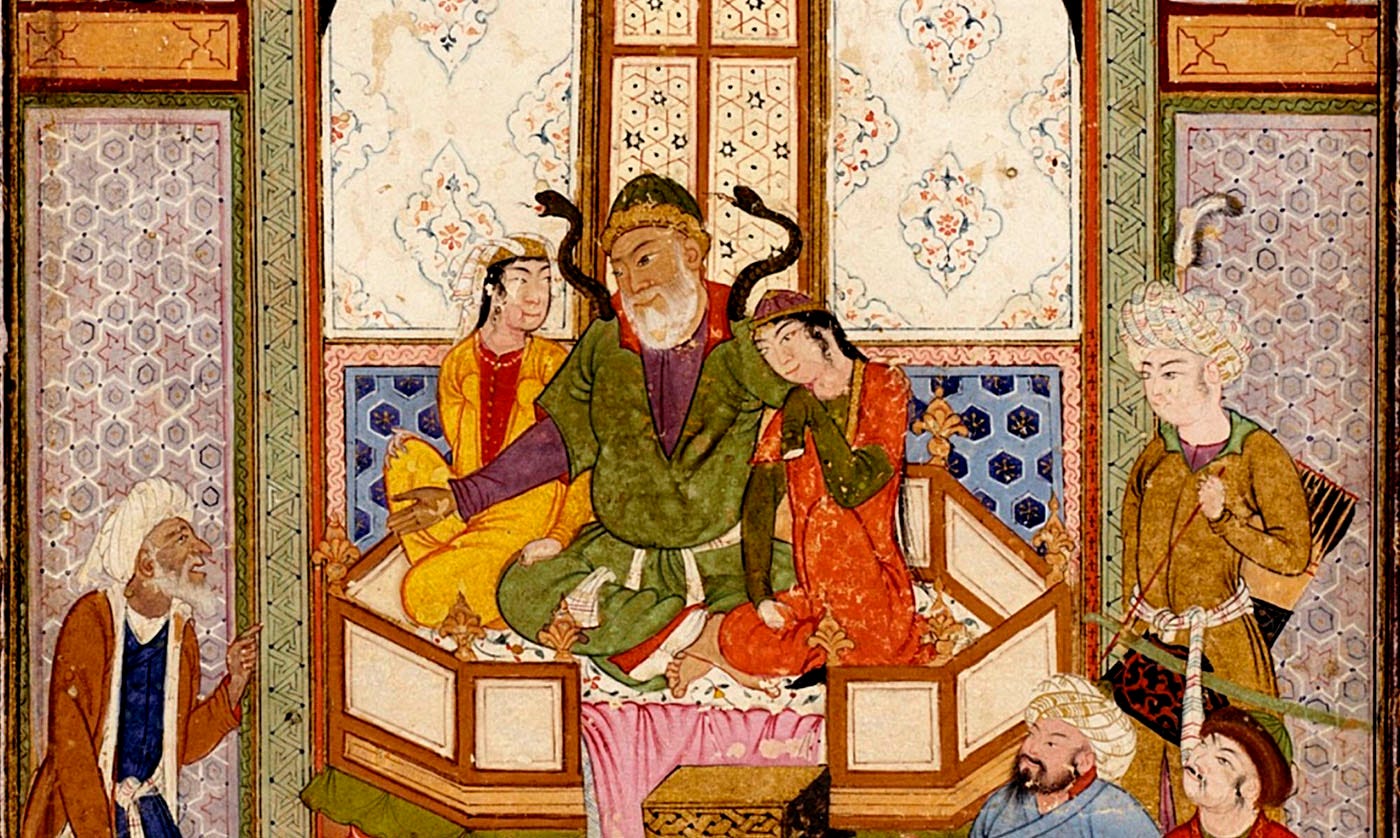
In the Shahnameh, Zahhak is not simply a bad ruler. He is the tyrant whose power is demonic, corrupt at the root, and literally fed by the young: after Ahriman kisses his shoulders, serpents grow from them, and to calm them he must be fed each day with the brains of two young men.
Today protesters in Iran chant :
امسال سال خون است
ضحاک سرنگونه است
This year is the year of blood;
Zahhak is headed for overthrow.
and:
خامنهای ضحاک کشیدیمت زیر خاک
Khamenei, Zahhak, we dragged you beneath the earth.
This is what makes Ferdowsi’s place so unique. He is not merely revered. He is still inhabited by generations of Iranians, more than 1000 years later. His work survives not only in editions and libraries, but in the reflex that sends Iranians back to it whenever brutality, tyranny, or rupture demand a language larger than the present.
Our back-up is not military. It is literary and civilizational.
In writing the Shahnameh, Ferdowsi was not speaking only of his own survival. He was speaking of the survival of Farsi, and perhaps, already, of ours.
Lovely write-up, Mahnaz! I appreciate that you've highlighted Ferdowsi’s struggles in his later life due to a lack of patronage, which reminded me that Sultan Mahmud of Ghazni had short-changed him. Paid him in silver coins instead of gold, and in some versions Ferdowsi returned the amount; in others, they say he distributed it. It's clear that he felt humiliated and refused the payment.
A couple of years ago, I had the chance to listen to a talk by a historian and archaeologist on Persian culture. Ferdowsi came up, not just as a poet, but as a historical figure whose work was instrumental in preserving and elevating Farsi at a time when Arabic held strong prestige among the ruling and scholarly elite.
That mention stirred something familiar. It led me to get a copy of Shahnameh, which has been sitting on my shelf ever since. I have not yet mustered the discipline, or perhaps the courage, to read it with the attention it deserves.
Your piece feels like a gentle nudge, maybe even a necessary one. A reminder that some works are not meant to wait indefinitely, and that engaging with them is its own kind of journey. Perhaps it is time I finally begin.